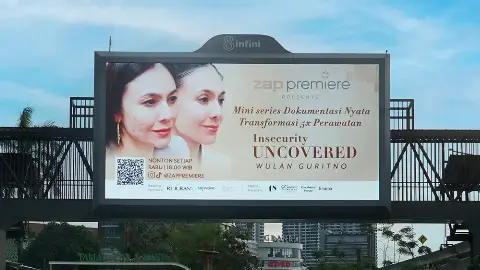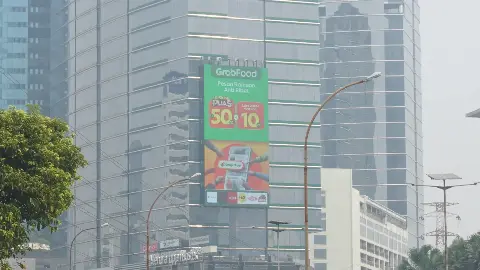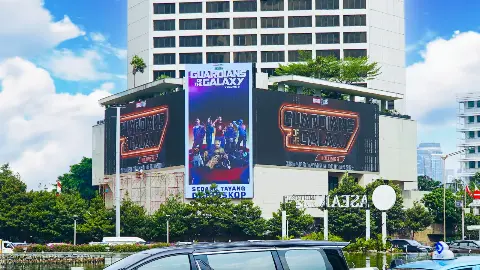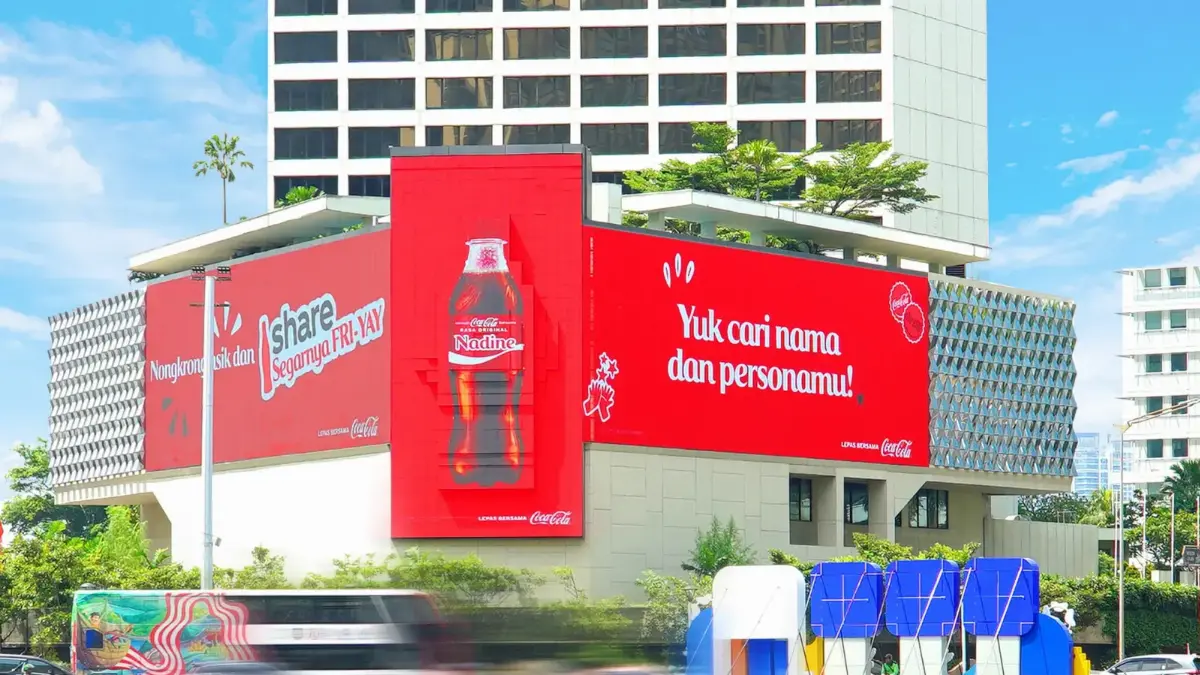
An anamorphic 3D billboard is a flat video file drawn with forced perspective, so that from one calculated position the object on screen seems to burst out of the frame or sink deep into the building. Step away from that position and the effect falls apart. That is why the first question for any brand planning one in Jakarta is not the concept but the viewer's position: where, exactly, do people see this screen from? The answer decides which screen is worth booking, which kind of illusion will hold, and how many revision rounds you should budget for.
How an anamorphic 3D billboard works on an LED screen
The 3D studio builds the scene in software and places a virtual camera where the target viewer's eyes will be, for example a driver in the middle lane some distance before the screen. The camera's view is then projected onto the real surface of the screen. From that spot, lines that are actually slanted on the LED read as a box, a floor or a wall with depth. Move too far left, right or closer, and objects begin to stretch.
There are two ways to use the principle. On a corner or multi-sided screen, two physical surfaces meet at a real angle, so an object can cross from one face to the next and appear to sit inside the building. On a single flat face, the studio draws a false frame instead: a hollow box, a shattered pane, a digital window ledge. The object then breaks through that frame, and a shadow falling "outside" the screen is what convinces the eye.
The practical consequence: one anamorphic file is built for one screen with a specific geometry and pixel resolution. Content made for screen A will almost always look wrong if it is simply played on screen B with a different ratio.
Reading the site geometry before you brief a studio
Jakarta's DOOH inventory comes in very different shapes, and each shape suggests a different kind of illusion.
Three faces at Bundaran HI: LED Mandarin
LED Mandarin, on the Mandarin Oriental Hotel, faces Bundaran HI and is made of three faces measuring 27 x 9 m, 8 x 16 m and 27 x 9 m. It is the closest thing in our inventory to the classic corner anamorphic: an upright centre face flanked by two wide faces, which lets an object travel across the faces and look as if it lives inside the building. Before the concept is locked, ask for the technical drawing showing the angle between faces, any frame or gap at the joins, and the pixel resolution of each face. Studios often ignore the joins, and a dark seam can slice an object right through the part you most want people to see. Read the robotic LED at Bundaran HI page as well, so the idea fits how this screen is operated.
A tall portrait face on Gatot Subroto: LED Jamsostek
LED Jamsostek is a single 15m x 30m face standing on Jl. Gatot Subroto. A ratio that tall suits vertical illusions: a bottle dropping from the top and hitting the lower edge of the frame, a car rolling out of an office window, a stack of rooms receding into the tower. Because the face is so high, the viewer's eye sits far below its top edge. The studio needs to render for that upward angle rather than for an imaginary viewer level with the middle of the screen.
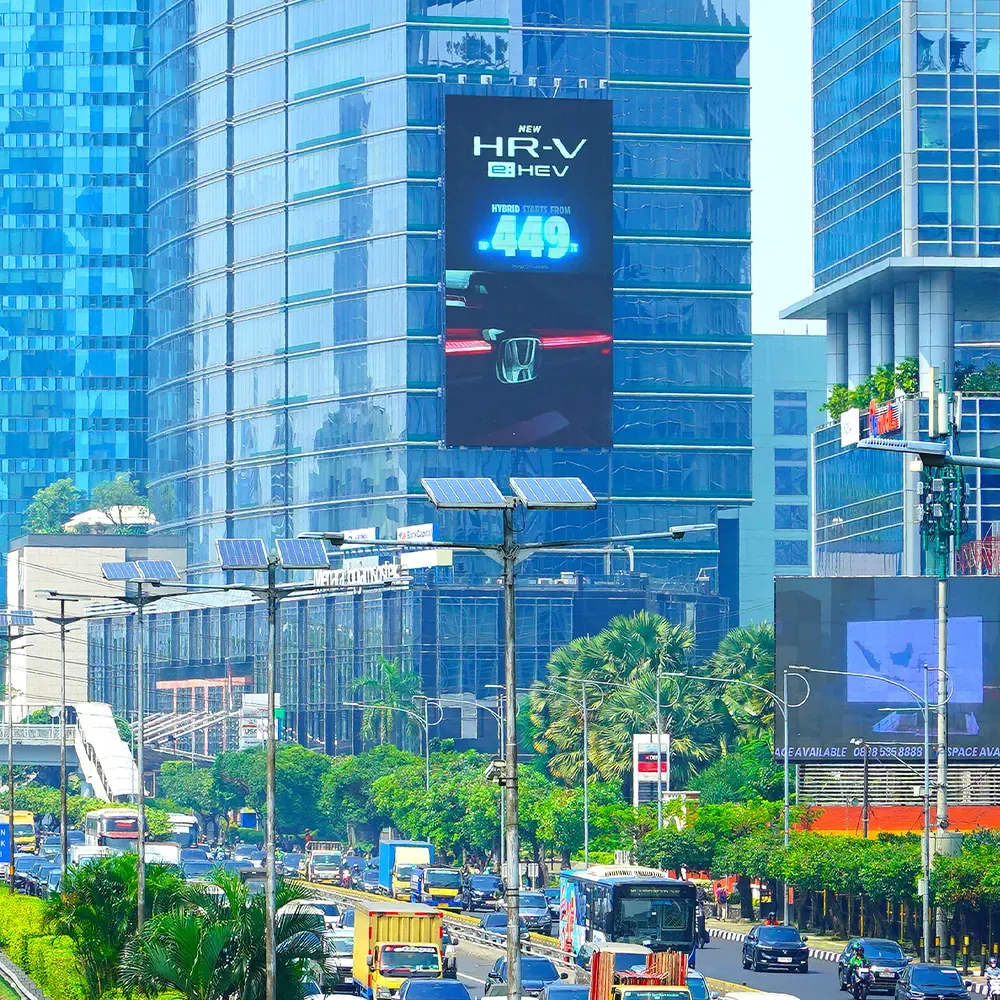
Landscape faces on road corridors: Mega Anggrek and Slipi
LED Mega Anggrek A (facing towards Tangerang) and Mega Anggrek B (facing towards Semanggi) are each 9m x 18m single faces on Jl. Arjuna Selatan. LED Slipi on Jl. Letjen S. Parman is also 9m x 18m and faces towards Semanggi. Viewers here approach from a long way off, and their angle keeps shifting as the car moves. Under those conditions an inward illusion, a room that recedes behind the frame, usually tolerates angle changes better than an object leaping out. Keep the pop-out moment, but schedule it at the peak of the loop, when vehicles are closest to the ideal viewing zone.
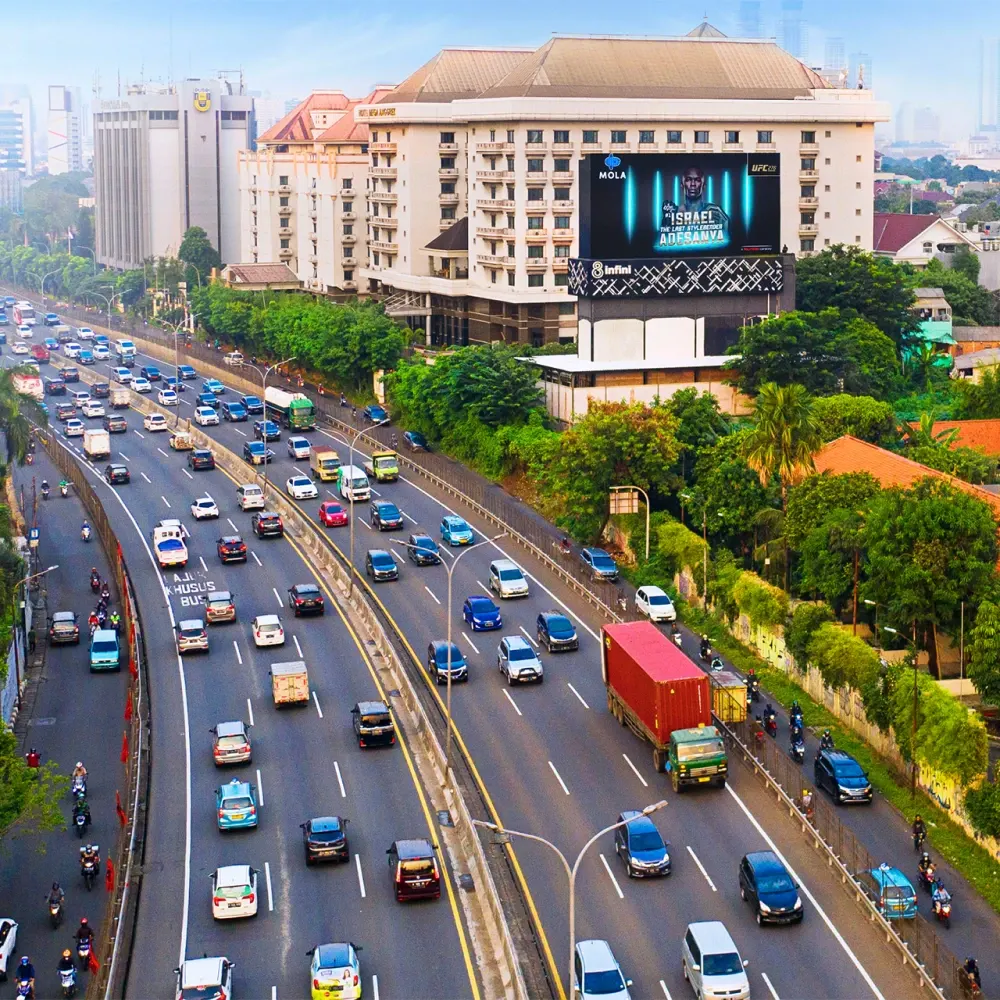
Choosing the sweet spot
The viewing point is a media decision, not a creative one. It depends on traffic direction, the number of lanes, where congestion builds, and whether a footbridge or tree blocks part of the screen. The most useful thing you can do is record video from the driver's seat in the busiest lane, starting where the screen first comes into view and ending when the car passes it. Pick one frame from that video as the reference for the virtual camera.
Give the studio three things: the reference photo from that position, the approximate distance and eye height of the viewer, and the pixel dimensions of the screen from the media owner. Without them the studio is guessing, and a guess that is off by a few degrees is enough to turn a crisp 3D box into a leaning trapezoid.
Shoot the night view too. Day and night references from the same spot often tell different stories. At night the surrounding structure disappears and depth is easier to fake; in daylight, reflective glass and a bright sky become part of the frame. A strong concept works in both, or at least you know in advance which hours show it at its best. On congested stretches the sweet spot becomes a place where people sit for a while, which gives them time to catch the reveal; on free-flowing roads the reveal has to arrive sooner and be simpler.
A production workflow that avoids surprises
- Site data and survey: dimensions, pixel resolution, facing, technical drawing and the driver's-eye video.
- Concept and storyboard built around one hero moment, not a reel of effects.
- A still mock-up: render one frame and composite it onto the reference photo for the brand and media team to check.
- Modelling, animation and final render at the screen's native resolution, with no rescaling at the end.
- An on-screen test, filmed from the same reference position in daylight and after dark.
- Revisions to lighting, contrast and logo placement based on that footage.
Step three is the one most often skipped, and it is where perspective errors cost the least to fix. A single composite on a real photo shows whether the object will be cut by the frame, hidden by a lamp post or too small at viewing distance.
Why 3D effects fail on the street
Subtle shading is the first casualty. In daylight the screen competes with the sun, and soft gradients that look dramatic on a studio monitor disappear. Push the contrast between "floor", "walls" and the hero object.
Text inside the distorted space is the second. Product names, offers and calls to action should sit flat on the screen plane, not dragged into perspective, so they stay legible from any angle. The legibility rules in our guide to videotron ad creative that Jakarta drivers remember apply to 3D work as well.
The third is a late logo. Anamorphic loops tend to run long because studios want to show off the effect, yet most drivers only catch part of a rotation. Make sure the brand is visible early and returns at the end. How slot length and frequency interact is covered in how long a videotron ad should run.
The fourth is one file for many sites. If the campaign runs on LED Mandarin and LED Jamsostek together, budget for two separate renders, or use a clean 2D version on screens that do not suit the illusion.
When 3D is the wrong tool
Anamorphic content works best for products with a clear physical form: packaging, vehicles, devices, shoes, film characters. For information-led messages such as interest rates, event schedules or promo terms, the effect competes with the text and slows comprehension. A clean 2D spot with one strong movement usually does more there.
Timing matters as well. Anamorphic production takes longer than standard videotron artwork because of the mock-up, render and test stages. A two-week campaign briefed a few days before airing is safer in 2D, with the 3D idea saved for the next launch. On the other hand, for a major launch whose screen footage will be filmed and shared on social channels, one site with a strong illusion is often more useful than many sites with ordinary artwork.
What drives the cost of an anamorphic 3D billboard
Think of cost in two parts. On production, the biggest factors are scene complexity (hard objects such as packaging are simpler than water, fabric or hair), animation length, the number of versions for different screens, and revision rounds. On media, cost depends on the site, campaign length, slot duration and play frequency. Local advertising tax and content approval also apply, and our team can walk you through the process for the sites you choose.
We do not publish figures because every combination of site and concept is different. For a quote, message the team on WhatsApp at +6282288108888 or through the contact page with the sites you are considering and your campaign dates.
Next step before you brief the studio
Send us your product or visual idea and a shortlist of sites. We will put together what a 3D studio needs for each screen: dimensions, facing, technical drawings and photo or video from the viewing point. With that pack, the studio can quote accurately from the first round. The full screen list is on our DOOH LED videotron page.