
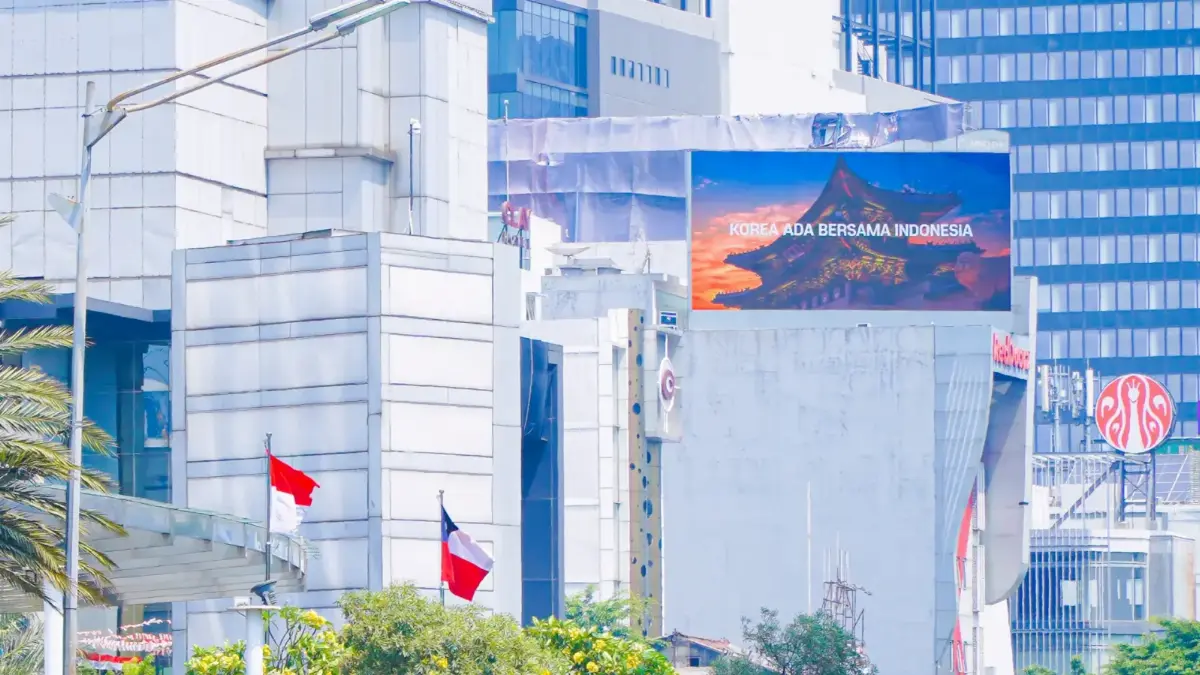
For most awareness campaigns on Jakarta's roadside screens, a 15-second spot with a single message will outperform a 30-second edit. How often it plays is not something you order directly. In the Indonesian market, frequency falls out of three variables: the loop length at each site, the screen's operating hours, and the number of days you book. If you are planning a DOOH buy in Jakarta from a regional office, those three numbers matter more than the headline slot length on the proposal.
Here is how we walk international brands and agencies through the maths, using screens we operate in Jakarta and Bandung as reference points.
How DOOH is typically sold in Jakarta
Teams used to programmatic DOOH in Singapore, Australia or Europe often expect impression-based pricing and audience guarantees. Most premium roadside LED in Jakarta is still bought by site, by slot length and by period. You are buying a share of a loop on a specific screen for a specific number of days. That makes the brief simpler, but it also means you need to ask the right questions before comparing two proposals:
- Slot length: how many seconds your creative runs per rotation, usually 15 or 30.
- Loop length: the total duration of one full rotation of all advertisers on that screen. Fewer advertisers in the loop means your spot comes back more often.
- Operating hours and flight dates: when the screen is switched on each day, and how many days, weeks or months you are on air.
Two proposals with identical slot lengths can deliver very different daily play counts. Always ask for loop length and operating hours per site, not just the location name and screen size.
Choosing a slot length
The right length depends on who is looking and how long they have. A driver on an arterial road catches a screen for a few seconds before their eyes go back to the traffic. A shopper walking through a mall atrium, or a commuter waiting at a bus stop, gives you far more time.
15 seconds for roadside screens
Use 15 seconds for one product, one line and one logo. At the same budget, you typically get more rotations per day than with a 30-second slot, so passers-by have a better chance of catching you at any point in the cycle. Build the edit so that any three-to-five-second window still makes sense on its own, and put the logo and product on screen from the first frame. The TV habit of saving the brand reveal for the end does not survive on a highway-facing LED.
30 seconds for sequences and variants
A 30-second slot earns its place when you need to show several SKUs, run a serialised story, or rely on motion, such as an anamorphic 3D piece. Keep the brand visible through every scene change. And do not simply drop your 30-second TVC onto the screen. Slow openings and dialogue-driven scenes disappear on a silent outdoor screen.
Short static or lightly animated creative
For dated offers such as a weekend sale or a store opening, a static frame or a short, simple animation often reads faster than video. It is also quicker to produce, which lets you rotate creative weekly without a full production cycle.
Working out daily frequency
The formula is operating hours divided by loop length. The table below is an illustration of the arithmetic only, not the specification of any particular site. We provide the actual figures per screen in each proposal.
| Assumption | Scenario A | Scenario B |
|---|---|---|
| Operating hours | 18 hours | 18 hours |
| Loop length | 5 minutes | 10 minutes |
| Rotations per hour | 12 | 6 |
| Plays per day | 216 | 108 |
The number that gets overlooked is frequency per person. A Jakarta commuter usually passes the same screen once or twice a day, on the way in and on the way home. Hundreds of daily plays do not translate into hundreds of exposures for any individual. For that commuter, what adds frequency is the number of days you stay on air. This is why a one-week flight on a single screen often feels underpowered even when the play count looks impressive in the post-campaign deck.
You can raise frequency per person in two ways: extend the flight on the same screen, or add screens along the same route. The second option suits brands targeting one corridor, such as office workers moving between Sudirman, Semanggi and Gatot Subroto.
How long to stay on air
For a launch or a promotion with a hard end date, a one-to-two-week burst across several sites usually works best, because the goal is to reach as many people as possible with the same message in a short window. For a brand that is new to the Indonesian market and needs to build recognition, we more often recommend monthly flights on fewer screens, with creative rotation so daily commuters do not tune out.
If the budget is tight, resist the temptation to spread thinly across four cities for a week. Pick one city or one corridor, stay long enough to register, then review before expanding.
Site formats change the calculation
The robotic LED at Bundaran HI
LED Mandarin, on the Mandarin Oriental Hotel, is a three-sided robotic LED with panels of 27 x 9 m, 8 x 16 m and 27 x 9 m, facing the Bundaran HI roundabout in Central Jakarta. Here, duration is also about timing your content to the movement of the structure. Creative has to be built for the panel configuration, and we share the technical specifications at the start of the project so your production house is not guessing.
Large screens on traffic corridors
LED Slipi measures 9 x 18 m on Jl. Letjen S. Parman, facing traffic towards Semanggi. LED Dukuh Atas is 7 x 14 m, facing Jl. Jend. Sudirman towards Senayan. The audience is mostly drivers and riders, so the single-message, 15-second rule applies strictly. LED Mega Anggrek has two 9 x 18 m faces: Side A towards Tangerang and Side B towards Semanggi. Booking both captures the outbound and return flows on the same stretch of road, which is a simple way to lift frequency per person without adding locations.
Close-range and pedestrian screens
The two LED JLNT Satrio screens are 2 x 4 m, facing Kota Kasablanka and Tanah Abang respectively. LED Senopati is 8 x 4 m, facing SCBD. Mall screens such as those inside Agora Lifestyle Mall in Tanah Abang are seen from a few metres away by people walking or sitting. These placements can carry more detail, such as variant names, in-mall store directions or a QR code.
Bandung
In Bandung, LED Buah Batu A and B (each 4 x 8 m) face opposite directions, one towards the Padalarang toll road and the other towards the city centre. It is the same two-direction logic as Mega Anggrek, at a smaller scale.
Creative issues we fix most often
Many frequency problems are really creative problems. These are the issues we most often send back before a campaign goes live: the aspect ratio does not match the screen, text is too small or too dense for the viewing distance, the logo appears only in the final two seconds, dark low-contrast palettes wash out in the midday sun, and the message relies on audio that roadside screens do not play. Share a storyboard with us before final production. Fixing it at that stage costs far less than re-editing a finished film.
Planning for Q4
October is the right time to lock in November and December. Demand for prime Jakarta inventory tends to rise ahead of year-end shopping promotions, Christmas and New Year's Eve. If your campaign is tied to those dates, prepare two or three creative versions: a teaser, a main offer and a final reminder. Daily commuters then see the message progress rather than the same frame for six weeks.
What to send us
Cost depends on location, slot length, the number of slots in the loop, operating hours and flight length, so we do not quote a single generic figure. Send us your campaign objective, approximate dates, target areas or routes, and draft creative if you have it, and we will propose a combination of sites and durations that fits your budget. You can browse the full inventory on our media page and the DOOH and LED videotron service page, then reach the 8infiniooh team on WhatsApp at +62 822-8810-8888 or through the contact page for site recommendations and a proposal.

