Mall LED advertising in Jakarta beats roadside videotron in one situation above all: when the purchase can happen in the same building, minutes after someone sees the ad. A shopper drifting past an atrium railing is close to the screen, in no hurry and already planning to spend. A driver on Jl. Letjen S. Parman is watching brake lights. For regional and international brands planning Indonesian DOOH, the useful question is less "which is better" and more "which job does each screen do", because running the same 16:9 spot on both is the mistake we see most often.
This piece is written for brand managers and agency planners who are briefing a Jakarta campaign from Singapore, Kuala Lumpur or further away and need to understand how indoor mall screens and street-facing LEDs fit together. The examples come from inventory we operate, so the sizes and facing directions are real.
How mall LED screens and roadside LEDs differ in practice
Brightness and size are not the deciding factors. What changes is viewing distance, dwell time and what the audience can do next.
| Factor | Indoor mall LED | Roadside LED |
|---|---|---|
| Viewing distance | A few metres, from escalators and balconies | Long range, from moving vehicles |
| Audience state | Walking, browsing, in shopping mode | Driving, riding or sitting in traffic |
| What can be read | Product detail, offers, store location, QR code | One message, a logo, a strong image |
| Busy periods | Evenings and weekends | Morning and evening commutes |
| Screen shape | Often non-standard: long strips, pillars, portrait panels | Large rectangles facing traffic flow |
Put simply, mall screens give you depth of message and roadside screens give you daily reach among people who were not planning to shop.
When mall LED advertising is the stronger buy
Your product is sold in that mall
F&B, beauty, consumer electronics and fashion brands with a store in the building get the shortest path from seeing to buying. Creative can name the floor and the outlet. On a roadside screen, "Level 2, next to the escalator" is wasted pixels.
Time-limited promotions
Weekend discounts, bundle offers and the double-date sales Indonesian shoppers follow closely, such as 11.11 and 12.12, work better indoors because the audience can act on them immediately. Because the content is digital, you can swap the offer when it changes without a reprint. October is also the right moment to lock in year-end slots. Christmas, New Year and those sale dates fill mall screen schedules early, and late bookers tend to get whatever hours are left.
Launches that depend on close-up detail
Lipstick texture, a new colourway or a phone camera feature does not survive the trip to a car windscreen at speed. From a few metres away in an atrium, it does. If your global team has produced close-up product footage, an indoor screen is where it earns its keep in Jakarta.
When roadside LED is still the right call
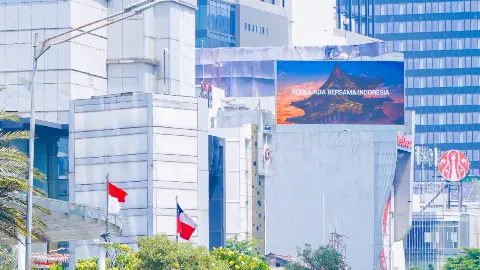
For city-wide awareness, street-facing LEDs remain the answer. Commuters pass the same location every working day, so frequency builds without anyone choosing to visit a particular building. A few reference points from our network:
- LED Slipi on Jl. Letjen S. Parman, West Jakarta: 9 m x 18 m, facing traffic towards Semanggi.
- LED Dukuh Atas on Jl. Blora, Menteng: 7 m x 14 m, facing Jl. Jend. Sudirman towards Senayan.
- LED Senopati: 8 m x 4 m, facing SCBD, close to South Jakarta's office and dining district.
- The Robotic LED on the Mandarin Oriental, overlooking Bundaran HI, with three screen faces and moving panels. It is the first robotic LED in Indonesia and is typically booked for launch moments that need to be seen in the city centre.
Choose roadside when the goal is broad recognition, when the product sells through many channels at once (marketplaces, convenience stores, dealerships), or when you need to reach decision-makers who rarely visit a mall on a weekday.
Indoor screens need their own creative
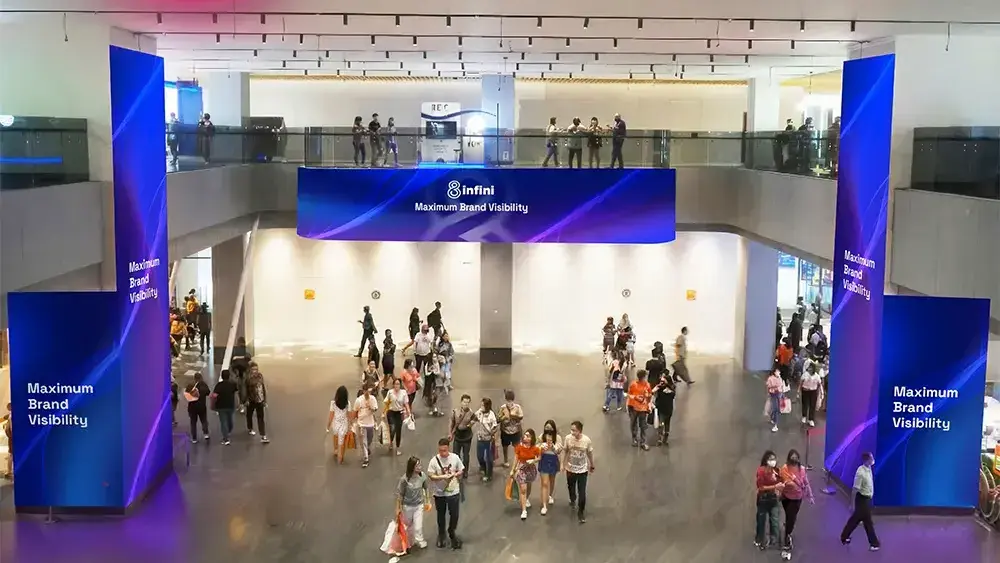
This is where international campaigns lose the most value. Indoor mall screens are rarely 16:9. At Agora Lifestyle Mall in Tanah Abang, Central Jakarta, LED Agora M & L1 consists of long strips measuring 19.84 m x 2.56 m and 20.8 m x 1.6 m wrapped around the balcony railings. LED Agora Pillar L2 & Sunken Garden L1 is 14.72 m x 2.08 m. LED Agora GF, next to Chagee, is portrait at 2.56 m x 5.76 m, and the Agora Skydeck screen is 4 m x 7 m.
A global TVC master forced onto a 20-metre strip ends up either letterboxed into a small box or cropped beyond recognition. What we ask agencies to do:
- Request the pixel specification for every screen before production starts, not after the edit is locked.
- For long strips, build the story horizontally: product moving across the frame, short copy at one end, logo at the other.
- For portrait panels, start from your vertical social cut. Reels or TikTok edits often adapt with light changes.
- Assume no audio. Every key message has to work in image and text.
- Use a QR code only where people actually pause, near escalators or waiting areas, and size it so it can be scanned from the floor below.
For guidance on spot length and how often a spot should appear per hour, see our article on videotron ad slot length and frequency in Jakarta.
The hybrid option: roadside screens at mall entrances
There is a third category planners often miss: outdoor LEDs placed at the approach to a mall. LED JPO Metropolitan Mall Bekasi, on Jl. Arteri Baru KH. Noer Ali, is a 6 m x 12 m screen mounted on a pedestrian bridge and seen by arterial road traffic, including people heading to the mall and the surrounding area. The Mitsubishi XFORCE campaign, for example, ran on this screen.
Placements like this suit brands that want to catch people before they walk in, such as an automotive exhibition inside the mall or a tenant opening a new store. Other locations in the city are listed on our digital billboard Bekasi page.
Sequencing both formats for the year-end season
For a November to December campaign, we usually recommend a sequence rather than a split. In the first two to three weeks, roadside LEDs carry awareness creative: one message, a large logo, a simple visual. When the promotional window opens, budget shifts towards indoor screens showing the offer, the store location and the end date.
Keep the key visual identical across both so that someone who saw the ad at Slipi or Dukuh Atas recognises it instantly in the atrium. Only the information density should change. If the campaign also includes a booth or activation inside the mall, schedule it for the same weekends as the indoor peak so screen and booth point people towards each other.
What drives the cost
We do not publish figures because the cost depends on the combination you choose. The main variables are the number of screens and locations, contract length (daily, weekly or monthly), spot length and spots per hour, and whether you need specific dayparts such as weekend evenings. With non-standard indoor screens, budget for adapting creative to several resolutions. For roadside LEDs, local permits and advertising tax shape how the quote is structured, and our team will explain this for each location you shortlist.
Full specifications, sizes and facing directions are on our media inventory page, and the DOOH LED videotron service page covers how we plan and run campaigns.
What to send us
Four things help us respond quickly: the product or offer you want to push, the flight dates, the target city or area, and the creative assets you already have with their formats. From that, we can propose a mix of mall and roadside screens and share the resolution specs your agency needs to start adapting. Send your brief via WhatsApp on +6282288108888 or through our contact page for location recommendations and a quote.