OOH media planning for a product launch in Jakarta works best when you start from the release date and count backwards. That date decides when artwork must be locked, which screens are still open, how long a teaser can run and when the on-ground activation should happen. Agencies that start from a shortlist of sites instead tend to find the headline LED already sold for launch week, or receive final artwork after the product has reached the shelves.
For brands planning from abroad, timing matters more than usual right now. It is mid-October, and Jakarta is entering its busiest quarter: launches are being pushed out ahead of the 12.12 online sale and the year-end holidays, while FMCG brands are already locking plans for Ramadan in early 2027. The most visible screens in the city get booked in that same window.
Start OOH media planning for a product launch from the release date
Three questions come before any site list. Is the release date fixed, or could it slip? A teaser that prints a date becomes a reprint job if the date moves. Which cities will have stock on day one? Screens in Bandung add little if distribution there begins three weeks later. And what single action should people take: visit a store, download an app, book a ticket or pre-order?
That third answer is the one most often skipped, and it shapes the media mix. An app launch needs a short name or a QR code people can act on. A film launch needs the release date to be legible from a moving vehicle. A new drink needs people to taste it, which gives sampling a much bigger role than it would have for a banking product.
Plan three phases, not one flight
A well-run launch in Indonesia usually has three phases with different jobs. Collapsing them into one flight tends to spend the whole budget on the same sites with the same message, and the audience tires of it before the product is even available.
Teaser: recognition before release
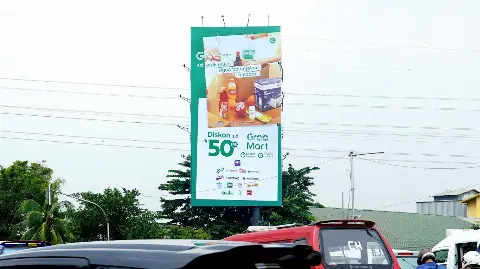
Media that moves and repeats suits the teaser stage. Advertising on Transjabodetabek buses puts the same visual in front of the same commuters several times a week as the buses run their daily routes. Static 8 x 16 m billboards such as Billboard Lebak Bulus (traffic from Fatmawati towards Lebak Bulus) or Billboard Kota Kasablanka (facing towards Kuningan) also work, because the image stays put for the whole contract period.
Avoid teasers that are too cryptic. Drivers have a few seconds at most. Show at least the brand or the product category plus the date. An unbranded teaser can easily end up promoting whichever competitor has the most similar product.
Launch week: peak frequency where people are already looking
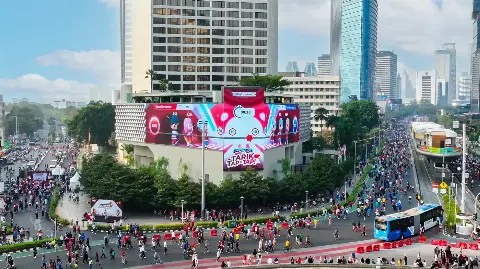
In release week, put the weight on screens with visual impact. The Robotic LED at Mandarin Oriental faces Bundaran HI with three sides (two at 27 x 9 m, one at 8 x 16 m) and is the first robotic LED in Indonesia. The moving structure is itself part of the show, which suits an "available today" message. Pair it with an on-ground activation in the same week so people have a reason to stop, try the product and take pictures.
Sustain: stay close to the point of purchase
After week one, shift spend toward sites nearer to where people buy. LED Senopati (8 x 4 m, facing towards SCBD) sits in a dense dining and office area. LED Slipi (9 x 18 m, towards Semanggi) catches traffic from West Jakarta. Once distribution widens, LED Buah Batu A and B in Bandung (4 x 8 m each) or the LED JPO at Metropolitan Mall Bekasi (6 x 12 m) extend the campaign beyond Jakarta using artwork you already have.
| Phase | Job | Typical media | Message |
|---|---|---|---|
| Teaser | Recognition of the visual and the date | Transjabodetabek buses, static billboards | Brand, key visual, release date |
| Launch week | High frequency and a moment people retell | Robotic LED, headline videotrons, on-ground activation | Product, "out now", call to action |
| Sustain | Reminders near the point of sale | LED screens in office corridors, malls and distribution cities | Benefit, where to buy, offer |
What past launch campaigns on our media looked like
For a regional team that has not bought Jakarta OOH before, it helps to see combinations that have actually run. A few launch campaigns that ran on 8infiniooh media:
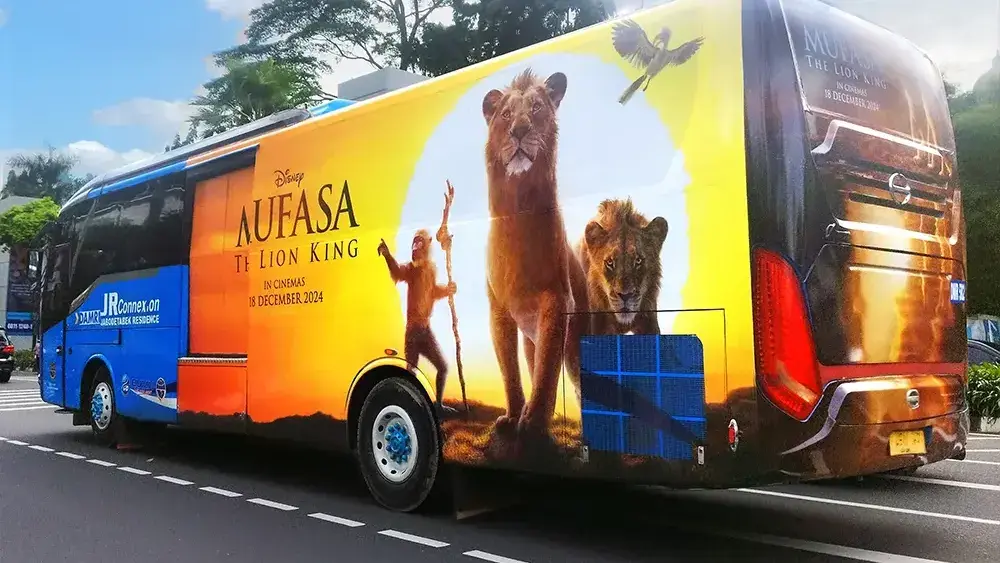
- Disney ran its Mufasa and Moana 2 releases on Transjabodetabek buses, with the cinema release date printed on the bus body.
- Samsung ran Samsung S24 on LED Mandarin and LED Senopati, and Samsung Unpacked on LED Mandarin.
- Mitsubishi ran the Mitsubishi XFORCE campaign on the LED JPO at Metropolitan Mall Bekasi.
There is a pattern. Film releases lean on moving media and put the date front and centre. Consumer electronics go big in the city centre at the moment of release. Automotive picks corridors where likely buyers live and shop. None of these is a formula, but each is a reasonable starting point for a brief.
One idea, many screen shapes
The most common failure in multi-format launches is artwork designed for one canvas and stretched across all the others. LED Jamsostek on Jl. Gatot Subroto measures 15 x 30 m, LED Dukuh Atas 7 x 14 m, and the JLNT Satrio A and B screens are 2 x 4 m. A bus wrap has windows, doors and tail lights cutting through the image. Each needs its own layout.
What should stay fixed is the key visual: colour, the product shot or character, and one headline. Everything else adapts. For LED, produce teaser and launch versions from the start, so switching on release day is a file upload, not a redesign. If you are working out spot length and plays per hour, our piece on videotron slot length and frequency covers the trade-offs.
Connecting screens, street and social
An activation earns more when it sits near a screen running the same campaign. A sampling booth or photobooth close to the LED gives visitors context: they saw the product on the screen and can hold it a few minutes later. Their photos and videos often include the screen in the background, which gives the launch a second life on social feeds.
On the digital side, have three things ready before the first play: a live landing page, a social team able to reply to comments, and proof-of-play documentation from every site. Brand teams often post that documentation on day one. Keep claims in artwork and posts provable; Indonesia's advertising code (Etika Pariwara Indonesia) restricts superlatives that cannot be substantiated.
A working sequence for international teams
How long each step takes depends on the number of sites and the complexity of the activation, so treat this as a checklist rather than a fixed schedule:
- Lock the release date, launch cities and the one action you want people to take.
- Ask for site recommendations and check availability for all three phases at once, especially for November and December releases.
- Approve the key visual, adapt it to each format and submit artwork for media-owner approval.
- Work through permits and advertising tax with the media team, particularly for activations in public spaces.
- Produce printed media for buses and billboards first, since they need installation time; LED files can follow.
- Prepare the release-day replacement artwork and test it on screen.
What drives the cost of a launch campaign
Cost depends on the number of sites, screen size and location, the length of each phase, spot length and play frequency on LED, the number of buses and contract length for transit, print production, and the scale of the on-ground activation, including crew, interactive hardware and venue permits. Season matters too, since fourth-quarter demand is usually heavier. With so many variables, a sensible figure can only be worked out once the three-phase plan is reasonably clear.
What to send us for a launch proposal
Share the release date or date range, launch cities, target buyer profile, any existing artwork, and whether you need an on-ground activation. With that, our team can propose sites for each phase and check what is still available. Reach us on WhatsApp at +6282288108888 or through the contact page for site recommendations and a quote.