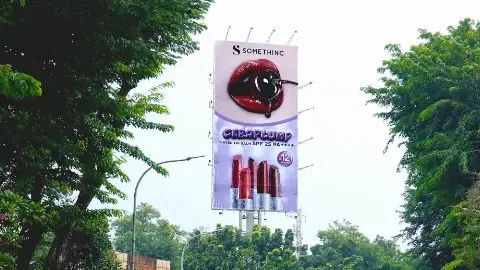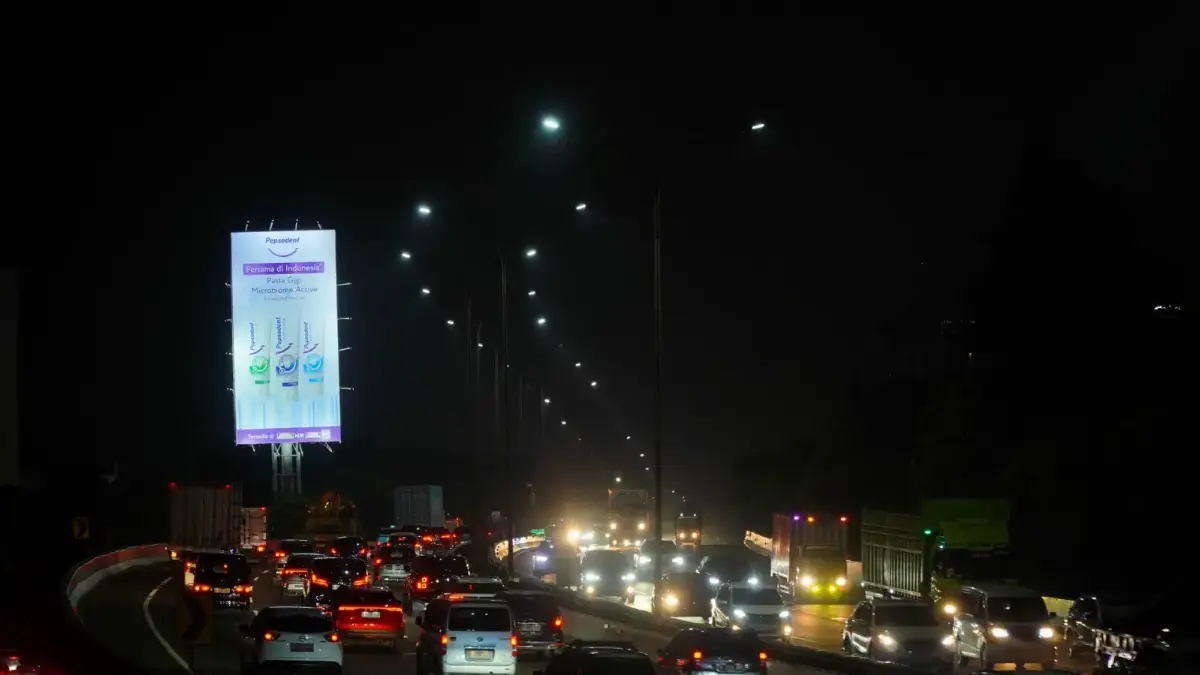
The most reliable way to measure billboard visibility is still a drive-by: get into the lane your audience actually uses, start a stopwatch when the panel becomes readable, and stop it when the panel leaves the driver's field of view. Traffic counts from a media owner tell you how many vehicles pass a site. They do not tell you whether anyone in those vehicles can see your artwork. In Jakarta, two sites on roads with similar volumes can perform very differently because one sits at the end of a long straight and the other is half hidden behind a pedestrian bridge.
This is how we assess a static billboard site at 8infiniooh before recommending it to a brand or agency, including the checks that regional and international teams most often skip when they plan Jakarta from a spreadsheet.
Traffic volume and visibility answer different questions
Volume answers "how many, and who". Visibility answers "for how long, and how clearly". A brief that simply asks for the busiest roads tends to produce a weak plan, because the busiest corridors in Jakarta are also the most visually crowded: competing panels, pedestrian bridges, overhead cables, elevated toll roads and flyovers.
A better sequence is to define the corridors your audience moves through, screen the sites on those corridors for visibility, and only then use traffic data to choose between the sites that passed.
How to measure billboard visibility on site
Run the survey from a vehicle in the lane that faces the panel, with one person driving and one taking notes. Record the approach with a dashcam or a phone on a mount. The footage becomes your evidence when the regional office or the client asks why one site was chosen over another.
First legible distance and viewing time
Note where the panel first becomes legible, not where it first appears as a shape on the horizon. Then time how many seconds it stays fully visible. Do this at least twice: once in free-flowing traffic and once in congestion. The gap between the two runs is the real window you have for your message, and it should decide how many words your artwork can carry.
Panel angle against the flow of traffic
Facing direction is the first thing we list for every site. Our Lebak Bulus billboard on Jl. RA Kartini in South Jakarta measures 8 x 16 m and faces traffic travelling from Fatmawati towards Lebak Bulus, so it works for southbound vehicles on that stretch and not for the opposite flow. Lane position matters as well. Jakarta roads carry a heavy share of motorbikes, which mostly keep to the left lanes, while cars overtake on the right, so the two groups see the same panel from different angles.
Obstructions that change over time
Trees grow, temporary banners go up, construction hoarding appears overnight. A survey photo from last quarter may not reflect today's sightline. Ask the media owner for recent, dated photos taken from the driver's point of view. We photograph our sites regularly during each campaign, including after dark, so clients can see the real condition of the panel rather than a launch-day image.
Night-time performance
Jakarta's commuter corridors stay congested well into the evening, which makes night visibility part of a site's value. Check whether the floodlights cover the whole face evenly, and whether street lighting or a brighter neighbouring display drowns your panel out. Artwork with a light background and dark type usually holds up better at night than dark, moody creative that only looks good on a laptop.
Reading traffic data without being misled by it
Once a site passes the visibility check, combine several sources to understand who passes it:
- Media owner data. Ask for the source, the counting method and the date it was last updated. Treat undocumented figures as estimates.
- Congestion patterns from a mapping app at different times: weekday morning, midday, evening and weekend. You will not get vehicle counts, but you will see when the road slows down.
- A short manual count at peak and off-peak hours, split by vehicle type: motorbikes, private cars, public transport and trucks.
- The character of the surrounding area: offices, malls, campuses, housing or logistics routes.
Vehicle mix often matters more than the total. A road dominated by freight trucks is worth something different to a beauty brand than a road full of private cars heading to office districts. Congestion cuts both ways too: drivers look at a panel for longer, but their attention is split between the car in front and their phone.
How we read some of our Jakarta billboard sites
The table below uses data from our static billboard inventory. The last column is not a rating. It lists the questions we answer on the ground for each site.
| Site | Location | Size | Facing | What we check on site |
|---|---|---|---|---|
| Billboard Lebak Bulus | Jl. RA Kartini, South Jakarta | 8 x 16 m, single face | Fatmawati to Lebak Bulus | Legible distance from the curving elevated approach, night lighting |
| Billboard TB Simatupang | Jl. TB Simatupang, Cilandak | 8 x 16 m, single face | Towards Lebak Bulus | Position relative to the elevated road structure, motorbike and car mix |
| Billboard Kota Kasablanka | Jl. Dr. Saharjo, South Jakarta | 8 x 16 m, single face | Towards Kuningan | Roadside trees, viewing time while queuing at the lights |
| Billboard PGC | Jl. Dewi Sartika, East Jakarta | 8 x 16 m, single face | Towards Jl. Raya Bogor, Cililitan | Motorbike density at the junction, cables and poles in front of the face |
| Billboard Arjuna A and B | Jl. Arjuna Selatan, West Jakarta | 6 x 12 m | Two panels, two directions | Which panel faces your main audience flow |
A brand can also split a campaign across sites that face different flows. Grab Food, for example, ran on both Billboard PGC and Billboard TB Simatupang, two corridors with quite different traffic. Decisions like that are easier when both sites are surveyed with the same method.
Common mistakes when sites are chosen from a desk
The first is judging a site from a mockup. Mockups are shot head-on, in clear daylight, from an angle no driver ever has. Ask for photos taken from the road, from the facing lane, and compare them with the mockup before signing off.
The second is assuming that a bigger face is automatically more visible. An 8 x 16 m panel partly blocked by a pedestrian bridge can underperform a 6 x 12 m panel standing clear at the end of a straight. Size only matters once sightline and obstructions have been checked.
The third is surveying at the wrong time. A team that visits on a quiet Saturday afternoon sees an empty road and a long viewing window, while the target audience passes during the weekday morning commute under completely different conditions. Match the survey to the hours your audience is on the road.
A survey checklist to send to your media partner
- Drive-by footage from the facing lane at peak and off-peak hours.
- First legible distance and full viewing time, in seconds.
- A list of obstructions: trees, pedestrian bridges, cables, other panels, construction.
- Night photos showing lighting quality.
- Vehicle mix and the character of the surrounding area.
- The source and date of any traffic figures supplied.
- The maintenance plan and photo-reporting schedule during the flight.
What the survey changes in cost and creative
Static billboard cost in Jakarta depends on the corridor, panel size, contract length, production and installation, plus the local advertising tax and permits that apply in that area. A visibility survey does not change the rate, but it tells you whether a site is worth it, and it stops you paying for a large face that drivers see for two seconds.
It also rewrites the creative brief. If a panel is only visible briefly from a curving approach, the artwork needs one message, a large logo and an obvious product shot. We cover that in more detail in our piece on readable billboard design for Jakarta roads. Permit and tax rules vary by area, so bring our team in early rather than treating them as an afterthought.
Next step
Send us three things: the city and corridors you want to cover, your audience profile and your campaign dates. We will put together a shortlist from our static billboard inventory with recent site photos and facing directions, so you can compare before you commit. If the plan also needs LED or bus media, the full list is on our media page.
Message us on WhatsApp at +6282288108888 or through the contact page for site recommendations and a quote.