Brand activation gamification works in Jakarta when the game mechanic carries the product message. A visitor packing virtual boxes on a touchscreen is learning how a snack gets made. A visitor kicking a virtual ball across a projected pitch is feeling the energy an energy drink wants to sell. Once the game drifts away from the product, you are left with a crowd and no brand recall. Below is how we at 8Infini approach games for booths and activations in Indonesia: choosing the mechanic, sizing play time and queues, setting prizes, putting scores on big screens, and measuring the outcome honestly. If you are planning from abroad for an Indonesian launch, the local notes on malls, permits and data law are the parts to read twice.
When brand activation gamification earns its place
Games make sense when a brand needs more contact time than a walk-past. Products with a process story (snacks, beverages, skincare), products with features people should try (apps, devices, digital banking), and film or series launches with their own story world tend to fit well.
If the main job is mass sampling at rush hour, a game slows the flow. Sampling at a station entrance or a mall corridor works better with a fast loop: greet, hand over, point to the next step. Gamification can sit on top as a second layer, inviting people who already took a sample to play for a bigger reward.
One filter question for every concept: what should a visitor remember five minutes after playing? If the honest answer is "the booth was fun", rework the mechanic.
Game formats we see working on the ground in Indonesia
Each format below has different space and technical needs, which matters more in Jakarta malls than most international teams expect.
- Interactive floor projection: projectors and motion sensors turn the floor into a playing field. Good for sports or active-lifestyle messages. Needs low ambient light and a ceiling that can take a projector rig.
- Vertical touchscreen simulations: players complete one step of a process, such as packing product into boxes. Small footprint, so it fits mall corridors.
- Motion games in front of an LED wall: a camera reads body movement and the result plays on a large screen, so bystanders become an audience.
- AR filters and challenge photobooths: a short mission unlocks a branded photo or video frame ready to share.
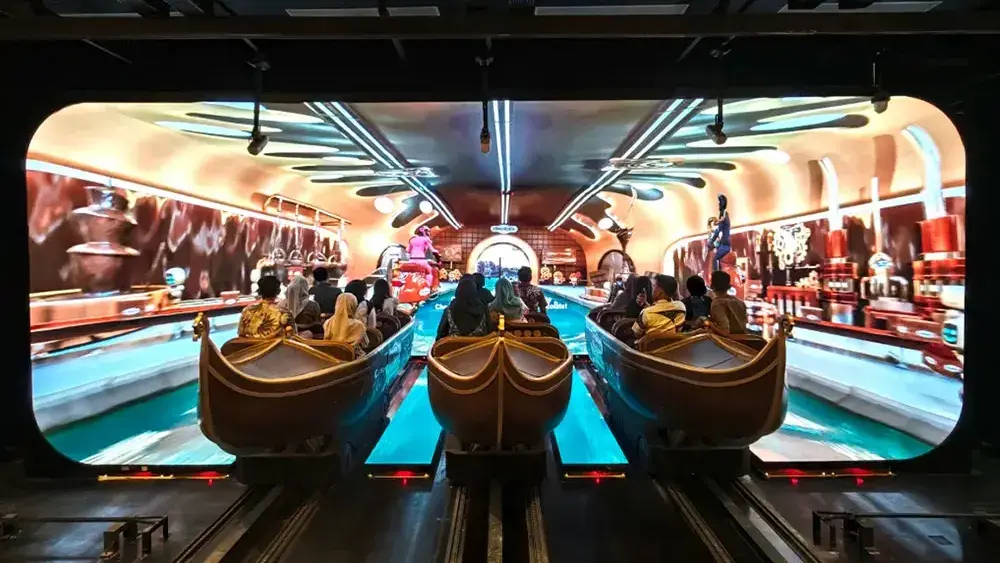
- Immersive rides: curved LED walls surrounding a vehicle or walkway. The heaviest investment, and the hardest experience for any other format to match.
Garudafood ran Chocolatos X-Quest and Gery X-Quest with 8Infini as on-ground digital activities. The Chocolatos X-Quest documentation shows two approaches side by side: a touchscreen simulating the box-packing stage, and a boat ride through LED walls that carries visitors into the product world. Bintang Toedjoe also used an on-ground digital activity, built around a football-themed floor projection game. We mention these to show the range of formats, not to claim results.
Calibrating difficulty
A brand game is not an esports final. Almost everyone should win on the first try, or at least feel close. We usually build two tiers: an easy base target for the standard prize, and a high score for the leaderboard. The second tier is what brings people back into the queue. Test difficulty with people outside the project team, because a team that has played fifty rounds will think everything is too easy.
Play time, queues and booth capacity
The most common mistake is a game that runs too long. Three minutes feels short to the player and endless to the fifteen people behind them. For public events in malls or open areas, a 60 to 90 second session usually gives one complete round.
Do the capacity maths before you sign off production. Add play time to briefing and changeover time, then divide sixty minutes by the result. A 90 second game plus 30 seconds of changeover is two minutes per player, roughly 30 players an hour per station. If the brand's daily target is well above that, add stations or a two-player mode. Do not cut the game down until it loses its meaning.
The queue is part of the experience. Put a screen showing the live game beside the line so people learn the rules before their turn. Registration staff with tablets can work the queue, so no time is lost at the station itself.
Mall and public-space practicalities
Indonesian mall operators set rules on sound levels, evacuation routes and load-in hours. Floor projection needs low light, so a bright daytime atrium often needs a canopy over the play area. Venue approval and technical requirements should be on the table from the first meeting. For activations in public spaces, our team helps check what permits apply.
Prizes and leaderboards on big screens
Prizes decide who shows up. High-value prizes attract prize hunters who ignore the brand; trivial ones make the queue feel pointless. Balanced options are full-size product, activation-edition merchandise, or vouchers redeemable only at the brand's outlets or online store. That last option leaves a trail you can count.
A leaderboard turns individual play into a show. For an activation at Agora Lifestyle Mall in Tanah Abang, Central Jakarta, the leaderboard could run on the 4 x 7 m LED Agora Skydeck, or on the long 19.84 x 2.56 m LED Agora M & L1 strip, which suits a row of top scores. The vertical 2.56 x 5.76 m LED Agora GF screen works for replays of the best plays. A live feed from booth to screen needs a technical check with our team before the concept is locked.
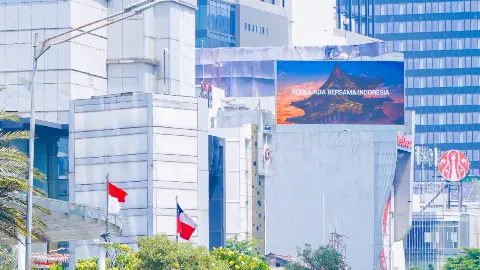
Wider campaigns can link the booth to roadside screens. The three-sided Robotic LED at the Mandarin Oriental, facing the Bundaran HI roundabout, has carried launch campaigns such as Samsung Unpacked; a call to play or weekly winner announcements can be scheduled there as part of a DOOH LED videotron plan.
Visitor data under Indonesia's PDP Law
Games are a common gateway for data capture, which is fine within clear limits. Indonesia's Personal Data Protection Law (UU PDP) requires explicit consent and a specific purpose. In practice, ask for the minimum. A nickname is enough to play; a phone number is requested only if the player wants a prize or follow-up, and that is stated on screen before they tap to agree. Never show full names on a public leaderboard. Children are often the keenest players at family events, so consent must come from the accompanying parent. Photos and video with visible faces also count as personal data, so offer a no-recording option.
Measuring engagement without vanity numbers
"Booth visitors" is an easy number to inflate and a hard one to verify. Better measures come from the game system, which logs every session: the share of players who finish the game, the number who replay to beat their score, voucher redemptions through an activation-only code, and shares carrying a dedicated hashtag or frame. Average queue time per hour is also worth logging, because it tells you whether day two needs another station. Agree on these metrics, who owns the data and the report format before the event opens.
What drives the cost
Costs vary widely, so a number without context misleads. The main drivers are game software (an adapted template versus a game built from scratch), hardware such as projectors, sensors, touchscreens or LED walls, booth production, the number of stations and event days, operator crew per shift, venue or mall space rental, and any media add-ons such as leaderboard airtime or a supporting videotron campaign. Weekends and holiday periods also see heavier demand.
Planning for Indonesia's year-end holiday season
Early October is a sensible time to start a December activation brief. Malls tend to lock atrium calendars for school holidays and Christmas early, and a custom game needs time for design, development and on-site testing. Teams often skip the on-site test, yet a motion sensor that behaves perfectly in a warehouse can act differently under atrium lighting.
A practical next step: write down the one product message visitors should remember, a target number of players per day, and the city or venue you have in mind. With those three, our team can propose a format from our on-ground digital activity service, size the stations and suggest supporting media. Send the brief via WhatsApp at +6282288108888 or through our contact page for a recommendation and quote.